Showing posts with label China Feed Trends. Show all posts

Monday, September 23, 2013

China feed mills importing US sorghum as corn replacement

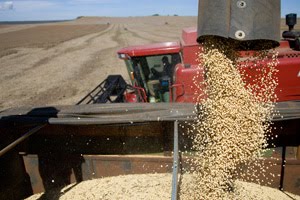
    China's private feed mills are increasingly turning to sorghum from the U.S. after using up their annual import allocations for preferred animal feed grain corn, according to reports.
    Rising Chinese imports are expected to boost sorghum prices over the next few months in the U.S., the world's largest producer, which is forecast to reap a bumper crop this year. U.S. sorghum prices are about $20 per metric ton higher than U.S. corn prices, partly due to China's buying, traders said.
    Private mills in China have used up their allocated 2.88 million metric tons of corn import quotas in 2013 and are not expected to ship in more corn until the end of the year when Beijing issues quotas for 2014. Domestic corn is not a viable option as it is way more expensive than U.S. sorghum.
    As an alternative, the mills have already bought about 800,000 metric tons of U.S. sorghum for shipment in the 2013-2014 year starting in September and total orders are likely to top 1 million metric tons, with prices still attractive, traders said.
    China issues a fixed 7.2 million metric tons of low-tariff rate corn import quotas annually under commitments made to the World Trade Organization, of which 60 percent is for state-owned firms. Corn is the preferred feed grain for mills as it produced widely and in large quantities.
    Imports of sorghum, similar in feed value to corn, are not subject to quota restrictions, and buyers need only pay a 2 percent import tax and 13 percent value-added tax on their purchases. Mills would be subject to a 65 percent import tax if they imported corn above their quota allocations.

Tuesday, May 14, 2013

Chinese feed supplier to invest RMB 1.26 billion in hog farm


    Chinese feed manufacturer, New Hope Group is investing RMB 1.26 billion in a vertically integrated hog farming operation in Chongqing. This is the first time, the company has expanded from feed manufacturing to such downstream links as live hog farming, slaughtering and intensive processing. 
    The feed manufacturer is investing RMB 850 million in pig slaughtering and processing. This project is scheduled to be completed around 2018. Annual live hog output capacity will reach 320,000 heads; slaughtering and processing capacity to 500,000 heads; feed consumption to 105,000 tons; pork production capacity to 28,000 tons and meat products to 8,000 tons creating additional output value of RMB 1.5 billion and profit of RMB 330 million. 

Wednesday, May 1, 2013

Chinese feed supplier announces new mill


    China Food Co. has announced that it has completed the construction of the company's new animal feed mill in Shandong province, China. The plant has capacity to produce 240,000 metric tons of compound feeds per year and 50,000 metric tons of premixes. Featuring feed machinery from Buhler, it replaces a 60,000 metric tons/year plant at the same location for the company's animal feed business called Fuss Feed.
    China Food Co. is also involved in producing soy sauces and other condiments. During 2012 it announced an outline agreement to divest its animal feed interests by selling Fuss Feed to Korean equity investor Wisehand Planning for $16 million. However, with the completion of the new feed mill and citing delays by Wisehand Planning in finalizing the acquisition, the board of the company has decided to terminate negotiations and consider action against Wisehand Planning and its shareholders under the guarantee for breach of its agreement. China Food Co. says it will now focus its efforts on increasing the new factory's production, while starting the sale process for the feed business again in due course as and when appropriate.

Wednesday, March 20, 2013

China feed mills double corn purchases in March


    Chinese feed mills bought 600,000 metric tons of U.S. corn in March, in nine cargoes for delivery starting in October, twice as much corn as they purchased in February. The purchase brings total imports to roughly 900,000 metric tons of corn so far for 2013, according to industry experts.
    Corn on the Dalian Commodity Exchange traded at 2,447 yuan per metric ton (about $10 per bushel) at 1:39 p.m. local time on March 13, while grain on the Chicago Board of Trade was at $7.1525 per bushel. Global demand will exceed supply by 13.7 million metric tons in the 2012–2013 season, according to the U.S. Department of Agriculture.
    China bought a record 5.23 million metric tons of corn from overseas in the marketing year ended September 30, 2012, and shipments for 2013 are forecast to fall to 2.5 million metric tons, according to the USDA.

Friday, June 15, 2012

Brazil may export corn to China


    Brazil is awaiting final approval to become an exporter of corn to China, adding the Asian country to a list of global customers that already includes the Middle East and various European markets, according to reports.
    Chinese technicians visited Brazil in March to assess the phytosanitary risks of Brazilian corn, a protocol required to open trade channels in a food commodity. Typically, pest and disease risks from imports are documented and some restrictions on origin of the commodity may be imposed.
    Brazil has produced a surplus of corn over the past few years, which has enabled it to export about 8 million to 10 million metric tons per year. Brazil is expected to produce a record 67 million-metric-ton crop in 2012 and export 11 million metric tons, according to the ministry's food supply agency Conab.

Friday, September 16, 2011

China to ban antibiotics as growth promoters

China's Ministry of Agriculture has announced a forthcoming ban on antibiotics as growth promoters in animal feed.
The ban is supported by the academic community, which believes that without antibiotics in animal feed, the health of animals will be better promoted, microbes' resistance to antibiotics will be lowered and food will become safer to eat.
Recent statistics show that in 2006 China produced 210,000 tons of antibiotics, and 97,000 tons were added to animal feed. Today it is estimated that 400,000 tons are produced annually.

Friday, July 15, 2011

China corn imports may more than double in 2011

China imported 540,000 metric tons of U.S. corn in the year beginning September 1.
China's corn imports may reach 5 million metric tons by the end of 2011, more than doubling the 2 million metric tons the country imported in 2010, according to Abdolreza Abbassian, senior economist with the United Nations' Food & Agriculture Organization.
The country is attempting to boost stockpiles and slow the country's fastest inflation in three years, which currently sits at 6.4%, according to reports. China bought 540,000 metric tons of U.S. corn for delivery in the year starting September 1 and an additional 300,000 metric tons was sold to unknown destinations. This brings the amount of corn sold by exporters without declaring a destination to about 2.5 million metric tons, initiating speculation that the product was bought by China and suggesting that the country is already at roughly 3 million metric tons of imported corn for the year.
Corn traded at $6.5575 a bushel at 4:40 p.m. in Singapore on June 12 after rising 4% when the U.S. Department of Agriculture lowered their estimates on global stockpiles.

Monday, May 2, 2011

China poultry, fish feed producer reports 36% net income growth in 2010

China animal feed producer Guangdong Haid Group reported a net income growth of 36%, to 210 million Yuan (US$32.2 million), for 2010.
Haid sold 2.38 million tons of animal feed in 2010, including 1.32 million tons of poultry feed and 1.06 million tons of fish feed. In addition, said Haid, company revenue from southern China rose 34.74%, accounting for 68.93% of Haid Group’s total revenue in 2010. Revenue from eastern and central China rose 87.7% and 78.81%, respectively.
The company's future plans include increasing annual feed production capacity by 1 million tons in order to expand its market share.

Thursday, September 16, 2010

China feed market to grow as livestock demand increases

As livestock production in China increases, import/export group and food manufacturer Cofco predicts the country may double its industrial animal feed level by 2020, according to a Bloomberg report.
In 2009, animal feed output -- mostly from corn, soybeans and other oilseeds -- was at 148 million tons, according to Liu Xiaoyu, general manager of Cofco’s feed division. In just 10 years, that figure could increase to more than 250 million metric tons.
This growth has been spurred, in part, by livestock reform in the country, leading to more large-scale operations, and government assistance.
Liu said from 1980 to 2009, China's feed production grew at about 16% per year, with annual growth closer to 8% per year from 2000 to 2009.
Cofco is state owned and is China’s largest grain trader.

Monday, April 19, 2010

China on course for record feed output

China’s Ministry of Agriculture forecasts that total animal feed production in the country in 2010 will reach a record 140 million metric tons, about 6% more than the figure officially recorded for 2009.
An increase of 5.6% to 30.3 million metric tons has been reported by the ministry for national feed output in the first three months of 2010. Further rises are expected in the second and third quarter of the year, although a relative slowing may occur in the October-December period.
In the final quarter of 2009, Chinese mills produced more than 39.8 million metric tons of compounds, premixes, concentrates and straight materials for feeding to farm animals and fish.

Friday, March 5, 2010

Chinese seeks to limit feed imports

China’s State Council has released the Administrative Rules of Feed and Feed Additives (Revision Draft for Comment) to address the issue of melamine contamination in pet food and animal feed. The rule emphasizes the strict management of feed additives and restricts the direct sale of imported feeds and feed additives by foreign-funded enterprises. According to China Research Intelligence, the restrictions on foreign feed suppliers have more to do with protecting state-owned enterprises than enhancing food safety.
The research group reports that the rules address three areas of enforcement: monitoring new feed and feed additives, restricting imports and enhancing monitoring procedures for imports that are permitted, and regulating producers of feed and feed additives. However, the Chinese government has yet to establish a content standard for melamine.

The rules would:
*Restrict the direct sale of imported feeds and feed additives by foreign enterprises and individuals.
*Set up a supervisory system for the entire production process, including quality and safety control measures.
*Define the responsibility of businesses in product recalls.
*Require operators to track purchases and sales and prohibit them from repackaging and adulterating products.
*Prohibit breeders from adding substances to feeds and feed additives without regulatory approval.
*Define the responsibilities of administrators and producers during the monitoring period for new feeds and feed additives.

Wednesday, November 18, 2009

Major growth in China’s feed production

China’s National Bureau of Statistics reports the country's October feed production reached 12.298 million metric tons, an increase of 25.8% from the level in October 2008.
Added to the volume growth recorded for other months this year, the country’s total output of feed from January to October 2009 rose by 22% on an annual basis to 107.941 million metric tons.

Tuesday, November 10, 2009

China robust export market for soya beans

Processors increasingly turn to imports, which are cheaper and more plentiful, despite efforts to boost local soya bean output. Read the full article.