Showing posts with label World's Top Poultry Companies. Show all posts

Monday, September 28, 2015

World’s top 250 poultry producers of 2014

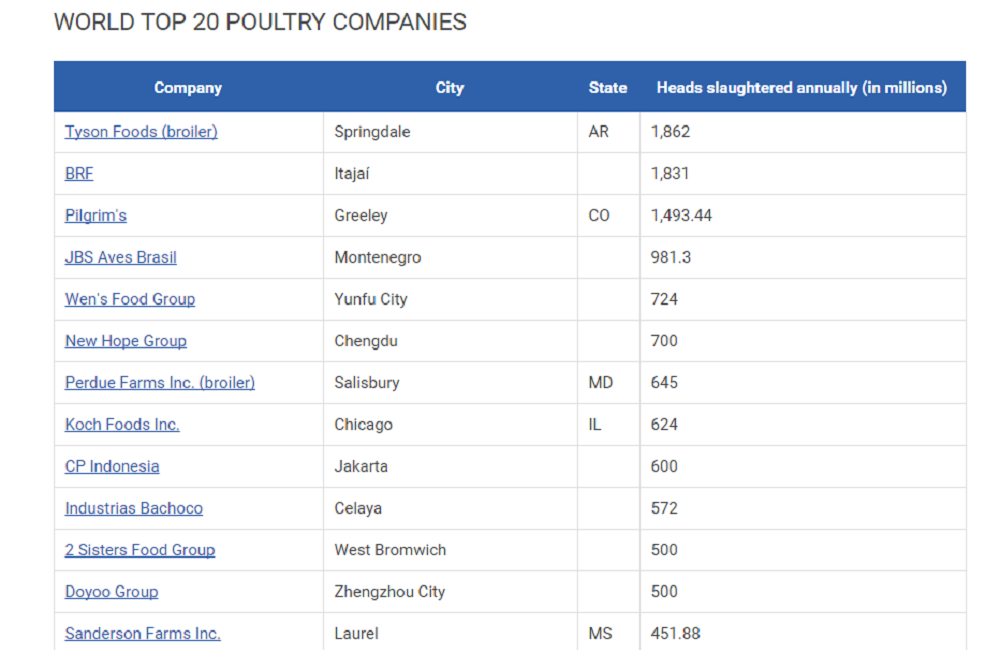
The editors of Poultry International, WATTPoultry USA, Egg Industry and Industria Avicola continue to expand our World's Top Poultry Companies database to include company data on the leading poultry producers worldwide. We define poultry producers as companies producing chicken, turkey, geese, ducks, table eggs, egg products, hatching eggs and day-old chicks. We present information on 200 of these companies in this issues of Poultry International. The full database – which includes more than 1,000 companies -- can be found at www.WATTAgNet.com/worldtoppoultry.html.
This is the sixth year of this listing, and have been steadily adding companies to our database. We continue to add more companies and refine the data on companies within the database. If your company is missing, or you wish to add or correct to the data we are showing, simply contact us at topco@wattnet.net.
We start the survey by collecting data from every available resource, combing our circulation lists and sending direct inquiries to readers of the magazine. We also use other research tools – advice from suppliers to the industry, association and governmental statistics, annual reports and business reports, websites, and other sources – to piece together a profile of each company in the database.

Our methodology  

Because we cover the world’s industry, there is no standard measurement for size or success across all countries. For major producing countries such as the United States or Brazil, we pick the top few companies – determined by number of head slaughtered per week – to include in the magazine but have much deeper data on those countries’ producers in the online database.
It is difficult to make size comparisons across different countries and markets. A large producer in Poland would be a small one in Brazil. So we go through the database country by country and pick the leading producers – whether it’s chicken, turkey, ducks, eggs or egg products – from each country and present them in this issue.
We classify companies as producers of chickens, turkeys, geese, ducks, table eggs, hatching eggs and egg products. We collect relevant data depending on the company’s production. Integrated poultry producers are listed with head slaughtered annually or weekly in high-volume countries. For egg producers, we list number of laying hens. We list numbers of employees, revenue and facilities when available.
This issue of Poultry International contains 250 companies – an increase from 200 companies listed in 2011. In order to get details on 250 companies in the issue, we changed to a table format for the listings, rather than the text listings we ran in 2011.
Each listing in this issue contains the name of the company, its headquarters location and a brief summary of the company. There is a link within each company’s listing that will take you directly to the company’s listing on WATTAgNet.com. There is more complete summary and additional data, such as production and sales volumes, specific types of production, and other facts listed in the interactive online database.
You will be asked register at WATTAgNet.com to view this data. Registration is free and only takes a few minutes.
In addition to further data on the 250 companies listed in this issue, the database contains data on more than 500 additional companies that did not make the cut into the magazine. Once you have registered on WATTAgNet.com, you can search the entire database and create your own lists of top companies in various regions and countries.
We’ve created several lists from the database, such as the Top 40 poultry producers, that appear in this issue. These lists and special downloadable files will also be available in the expanded Market Data section of WATTAgNet.com.
 This database is compiled by the entire WATT group of poultry publications – Poultry International, WATT PoultryUSA, Industria AvĂ­cola, and Egg Industry.

Tuesday, September 8, 2015

WATTAgNet.com Top Poultry Companies database in new, improved format

top poultry companies

The exclusive online Top Poultry Companies database has been expanded and improved with the mobile-friendly relaunch of WATTAgNet.com. The new database allows users to search for poultry companies worldwide by name, region or product. Poultry industry professionals can log in to view these listings, which include historical data such as annual revenue, products manufactured, geographic markets served and headquarter locations. The new site also includes a table where users can sort and study the capabilities of the companies in the database.
Registration is required to view this data, but it is free and simple. If you a registered user of the old WATTAgNet.com site, you will be asked to reset your password when you first log in.
 The entire site is now optimized for easy viewing on computers, tablets and smart phones. 

Wednesday, October 3, 2012

Top Poultry Companies Database expanded


      The World's Top Poultry Companies database contains information on the leading 800 poultry producers from around the world. 
    The publication of Poultry International’s October 2012 World Top Poultry Companies issue coincides with the expansion and new features on WATTAgNet’s Top Poultry Companies database. The October issue of Poultry International contains summaries of information on 300 of the world’s leading poultry producers. To see full information on those 300, plus 500 additional poultry companies check out Top Poultry Companies online database.
    Registration is now required to access the expanded database. In the past we have required registration on a limited number of articles, videos and other data on WATTAgNet. Registration is free, and requires only answering a few simple questions. If you have previously registered on WATTAgNet, simply login to access the database.
    Registration gives you full access to the database, and allows you to search it for specific companies, or search by region or country for lists of top poultry producers in that area.
    More details on how we collected data for the World’s Top Companies database can be found here.

Monday, October 3, 2011

World’s Top Poultry Companies--producers continue to invest, merge, expand, and respond to consumer demand

The October issue of Poultry International returns to our exclusive compilation of World’s Top Poultry Companies.
In this issue (view digital edition of this issue), you will find key data on the major players around the world. You can see, for example, what they produce and how much each year. World’s Top Poultry Companies, however, offers much more than this, and for the full version you will need to go to the online database.
We have redesigned the Top Companies online database, making it bigger and better; with more than 450 companies and growing. We’ve also simplified it, making it easier to search by region, country or company name. Individual company records contain details of area of activity, output, facilities and number of employees, along with overviews, addresses and website details.

More good news
Poultry is a sector that continues to grow and so, despite the political and economic turmoil of recent months, there is still some good news.
In the US, output of poultry meat increased last year, with 22 companies in the WATT PoultryUSA’s 2011 rankings reporting increases in ready-to-cook chicken production. Of the top 10 producers, eight posted increases in RTC chicken production on an average weekly basis in 2010. There are companies planning investment for the future, although some producers have cut back.
The World's Top Poultry Companies database features more than 450 companies and continues to grow.
In Europe, the climate remains difficult. While Europe’s economies are either shrinking or growing sluggishly at best, consumers remain cautious about spending, and producers not only have to contend with this but also with competition from overseas. Despite this, Europe’s producers continue to adapt and innovate, and cope with an ever-heavier regulatory framework.
1110PItopintor2.jpg
The database provides a listing of major producers by region, with each entry providing a link to detailed data.

While Asian economies may be outperforming their European and North American counterparts, growth is now slowing in China. Despite higher growth rates than most, the trend is now weakening.
Latin America may offer some cheer, but Brazil in particular is hampered by a strong economy.
The picture is not all doom and gloom, however. In an industry that remains fragmented, there are still opportunities for the bold. In Europe, for example, where the top three poultry companies account for the less than 15% of the market, HKScan’s purchase of Rose Poultry creates a major new player in the Northern European market.

Consumption to continue rising
While almost all sectors may currently be facing difficulties, one thing is for sure, consumption of meat will continue to rise. The OECD-FAO Agricultural Outlook predicts that, over the years to 2020, meat production will increase by 1.8% per annum and that this increase will be driven by poultry and pig production. The growth in demand over the period will largely stem from Asia, Latin America and oil exporting countries.
World meat exports are forecast to rise. At 1.7% annually, the rate may be lower than we are accustomed to, but remains, nevertheless positive. Again, poultry is predicted to be one of the two driving forces behind this increase, meaning that there are opportunities ahead. This more sluggish growth has been attributed to Russia’s policy of import substitution.
But do not think that the road ahead will be problem-free the sector. Volatility in feed prices is set to continue over the decade and the industry will be forced to look increasingly at improving feed efficiency. Alongside this, patterns of trade are shifting, as is consumer preference. While the world as a whole may be demanding more poultry meat, what people want and how people want it is constantly changing, offering both opportunities and challenges. Additionally, increasing numbers of countries are tightening their environmental legislation, which again, could benefit those companies agile enough to react but could cause problems for those that do not.