Showing posts with label Food Chain. Show all posts

Monday, January 11, 2016

Testing at egg company negative for Salmonella

The Missouri Department of Health and Senior Services (DHSS) recently conducted follow-up testing at the Good Earth Egg Company processing facility in Bonne Terre, MO. The results were negative for Salmonella bacteria. The facility has reopened after being ordered to close on Dec. 18 until remediation efforts and re-sampling could be completed.
The facility underwent cleaning and remediation efforts, and DHSS staff took new samples at the facility. Those samples were then tested at the Missouri State Public Health Laboratory and came back negative for Salmonella bacteria.
However, DHSS urges individuals that may have already purchased eggs from the Good Earth Egg Company to fully cook their eggs to 165 degrees, avoid cross contamination of raw eggs with ready to eat foods and wash their hands after handling eggs. Alternatively, consumers may choose to throw away any older products from Good Earth Egg Company.

Tuesday, January 5, 2016

Big food animal protein buyers talk consumer trends

Like their customers, animal protein buyers for General Mills Inc. and ARCOP Inc. are keeping an eye on the latest global consumer food trends.
In a presentation at the October 2015 Oilseed & Grain Trade Summit in Minneapolis, Drew Lein, markets manager for global dairy sourcing at General Mills, and Rohil Shah, a senior buyer at the Arby’s supply chain cooperative, discussed how changing consumer preferences for sustainable farming practices and pressure created by the 2015 outbreak of highly pathogenic avian influenza are influencing the way they do business.
Minneapolis-based General Mills is one of the largest food manufacturers and marketers in the world, with $17.6 billion in net sales in the company’s fiscal 2015 and $8.6 billion in net sales through the first two quarters of fiscal 2016. ARCOP, an Atlanta-based nonprofit supply chain co-operative for Arby’s Restaurant Group Inc., spends about $1.3 billion annually keeping the fast-food chain’s more than 3,400 stores in the continental U.S. supplied.

Sustainability

Around the world, consumers are becoming more concerned with where their food is coming from, Lein said.
“Consumers want to know more about their food. There’s a perception that, at companies, it is bad. We get a bad rap for that,” Lein said. “Consumers want their food to be more sustainable.”
In response to the demand, Lein said General Mills is pushing to have its top 10 ingredients – corn, cocoa, wheat, dairy, sugar beets, oats, sugarcane, vanilla, palm oil and fiber packaging – sustainably sourced by 2020. Specifically, the company is aiming to have liquid milk to demonstrate continuous improvement in terms of greenhouse gas emissions, water and energy usage.
A slide from Lein’s presentation said 20 percent of the liquid milk General Mills purchased in its fiscal 2014 was sustainably sourced.
Shah said ARCOP’s leadership shares General Mills’ concerns about sustainability, and its leadership is involved in the U.S. Roundtable for Sustainable Beef, a recently formed industry group focused on improving beef sustainability.

Organic, antibiotic, hormone and GMO free

Scrutiny on sustainable practices is also raising questions about the introduction of antibiotics, hormones and genetically modified organisms (GMOs) in animal feeds and how that affects the composition of the food that finds its way to the table. In reaction, consumers are turning to organic products.
When asked which of these four issues are most persistent among U.S. consumers, Lein said demand for organic is pervasive, but it’s a small segment of consumers who are pushing for organic products.
Shah said addressing antibiotic use in animal feed is a high priority. In September, Arby’s, along with a host of other fast-food chains, was issued a failing grade in a report on antibiotic policies authored by environmental groups like the Natural Resources Defense Council. The U.S. Department of Agriculture is also taking steps to eliminate antibiotics in animal feed.
The use of GMOs is harder to stop. Shah said GMOs are already present in animal feed, and his organization cannot drive its use through its current supply chain.
Additionally, Shah said changing the supply chain to match up with these trends creates concern about whether there is enough product to go around.
“If we were to go antibiotic free on chicken or on poultry, is that a sustainable supply? If there was a hiccup, what do we do? Do we go back to something that’s not sustainable?” Shah said. “We can’t really go back on our core consumers as well.”
Shah said he sees organic as something the company will need to consider in the future. Lein said the growing demand in the organic segment is putting pressure on the company to vertically integrate its supply chain to increase the availability of organic options.

Market volatility

As usual, the volatile pricing of protein commodities is a concern for ARCOP, Shah said. He said the 2015 outbreak of avian influenza obviously affected his company as it influenced the availability and pricing of turkey and eggs. Arby’s, he said, had to react quickly to find new suppliers and change its product formulas to ensure the company could still serve turkey and egg products at its restaurants.
“Market volatility is always going to be a factor. If it wasn’t, I am sure us commodity guys would be out of a job,” Shah said. “So, the reality is price volatility is always going to be an integral part in our lives and what we do.”
The past few years, he said, have been dubbed a “perfect storm” of factors, where poultry, pork and beef all saw strong year-to-year pricing gains while the supply was limited. The steadily increasing prices, coupled with the shortages caused by avian influenza, have pushed ARCOP to continue on its mission to find new markets and look for new suppliers who can provide a product, and a consistent price, as consistently as possible.

Wednesday, December 30, 2015

AdvancePierre Foods opens an innovative research center

AdvancePierre Foods has opened a customer Innovation & Research Center in Cincinnati, OH. It is a combination of lab space and meeting rooms that brings the R&D food labs and test kitchens to customers, creating the best opportunities to develop the products needed to grow their businesses.
Bernie Panchot, the company’s senior VP of research and development, emphasizes that customer collaboration is a guiding principle at AdvancePierre. “The new, interactive space complements AdvancePierre’s integrated product development process, facilitating enhanced cooperation between R&D, consumer insights, marketing and sales, all the while engaging customers at the most critical junctures in the product development process.”
Co-located with the company's processing facility, the center allows all factions of a team to work alongside customers in parallel by providing dedicated spaces for idea conception; food preparation – ensuring raw ingredients are isolated from ready-to-eat products; and testing. The center houses a sandwich and bakery lab; meat lab; processing lab; customer kitchen with adjoining conference room; additional meeting spaces; walk-in pantries, coolers and freezers; and a receiving room. In addition, the space incorporates a sensory lab in which internal screened testers evaluate products to ensure foods deliver the desired taste and eating experience.
“Customer satisfaction goes far beyond great-tasting products,” Panchot reveals. “It’s about trend-forward thinking, responsiveness, cost management, speed to market and consistency. It’s about identifying opportunities and solving the problems customers face, whether in a foodservice operator’s kitchen or in a grocery or convenience store setting. Heightened customer intimacy and collaboration empower us to detect these opportunities and to better solve these problems, ultimately, delivering an experience our customers will crave.”
AdvancePierre’s Innovation & Research Center utilizes equipment from home and commercial microwave ovens and steam-heating ovens to turbo chef-style ovens, convection ovens, grills and fryers to closely mirror how customers and consumers prepare products.

Wednesday, December 2, 2015

Wendy’s cutting pork from farms with gestation stalls

Quick service restaurant chain Wendy’s is planning to phase out serving pork and bacon sourced from farms that use gestation stalls, the company recently announced. The company has set 2022 as its target to source only crate-free pork.
The move away from gestation stalls is part of the chain’s Supplier Code of Conduct, released on November 23.
Since its founding in 1969 by Dave Thomas, Wendy's has operated under a core set of values and has enjoyed long-standing, collaborative relationships with some of the food industry's leading suppliers. This Code of Conduct takes into account the current best practices and standards of Wendy's supply chain and also identifies future aspirations to encourage continuous improvement in a meaningful way.
"When Dave Thomas was eight-years-old he dreamed he'd run the best restaurant in the world," said Emil Brolick, Wendy’s president and CEO. "Under his leadership, Wendy's helped to lead the way to set and enforce standards for the humane care of animals raised for our food as part of a responsible, safe and sustainable food supply chain.  Additionally, because of Dave's commitment to quality, he only wanted the freshest ingredients; therefore, he created an infrastructure that has allowed us to serve beef that has never been frozen along with other fresh ingredients, like iceberg and romaine lettuce, tomatoes and strawberries in our more than 6,000 North American restaurants."

Tuesday, November 3, 2015

AeroScalder is finalist in Dutch food innovations Top 3

Out of more than 50 candidates, the Marel Stork AeroScalder was one of three finalists for the Food Valley Award 2015, the prestigious Dutch prize for innovation in agrifood, feed and horticulture.
In their report, the Food Valley judges praised the AeroScalder's contribution to hygiene, food safety and environment in the poultry industry.

Every year, the Food Valley organization awards a prize for the best Dutch agrifood innovation. For the 11th edition of the Food Valley Award, the AeroScalder was one of the three nominees.

Energy saving
The Marel Stork AeroScalder is an innovative scalding system for loosening poultry feathers prior to defeathering. It saves up to 75 percent in water and 50 percent in energy compared to traditional immersion scalding systems. The AeroScalder is a closed system with moisturized hot air to loosen the feathers. The air is reconditioned for recirculation, creating a closed and fully controlled process. Unlike immersion, the process stays stable from beginning to end, so every product is treated identically. In addition, odor emissions are considerably lower.

Jury report
The Food Valley judges had a difficult choice to make in comparing two coffee products to poultry processing equipment. The jury was particularly impressed with the innovative techniques of the AeroScalder and sees global application opportunities. "The technology offers important advantages in terms of food safety and food quality, as the chance of cross-contamination by pathogens is significantly reduced. Besides that, considerable savings in water and energy use can be realized by applying this process. It is a very valuable development, which can add to ameliorated global food quality in an efficient and sustainable way. Therefore this innovation is justifiably one of the three nominees for the Food Valley Award 2015," says the jury report.

Marel Stork Poultry Processing is proud to have been nominated and congratulates coffeemakers Peeze for winning the Food Valley Award.
For more information about AeroScalder, click here.

Monday, October 26, 2015

Conference on food waste reduction held at EXPO Milano

On Oct. 15 the European Commission organized a high level conference at the EXPO Milano, in contribution to the search of EU food waste reduction solutions.
Former foodstuff processors, with EFFPA as the representative body at EU level, already prevent an estimated 3.5 million metric tons of food chain losses from going to waste by processing foodstuff no longer suitable for human consumption into feed for food-producing animals. Former foodstuffs are removed from the human food consumption market, by food manufacturers, because of unintentional and often unavoidable production errors.
Examples of former foodstuffs used in animal feed are broken biscuits and chocolates, surplus bread, incorrectly flavored crisps and breakfast cereals. In addition, surpluses resulting from seasonal festivities such as sports events, Easter and Christmas are used, after the food manufacturer has taken the options for food bank donation into account. Moreover, former foodstuffs must be in full compliance with EU feed safety requirements as well as the General Food Law’s demands as regards traceability to become eligible for feed use.
EFFPA President Paul Featherstone said, “It may surprise people, but energy-rich former foodstuffs like biscuits, chocolates and confectionary are highly valued resources in animal feed manufacturing. In fact, our end-product can be used as an alternative to cereal grains, thereby reducing the dependence on land-requiring raw materials, and thus the environmental footprint of foodstuffs of animal origin.”
EFFPA calls on EU policy makers to clarify the regulatory framework for former foodstuff processors through the planned proposal on the circular economy, making it clear that former foodstuffs are by-products and by no means legal “wastes.”
According to Featherstone, “It is clear that the safe use of former foodstuffs in animal feed contributes to a more sustainable food chain and should unambiguously be encouraged. Our innovation-driven, non-subsidized industry could still double in production within the EU with the right regulatory guidance.”

Wednesday, October 21, 2015

3 ways the poultry industry can gain consumer trust

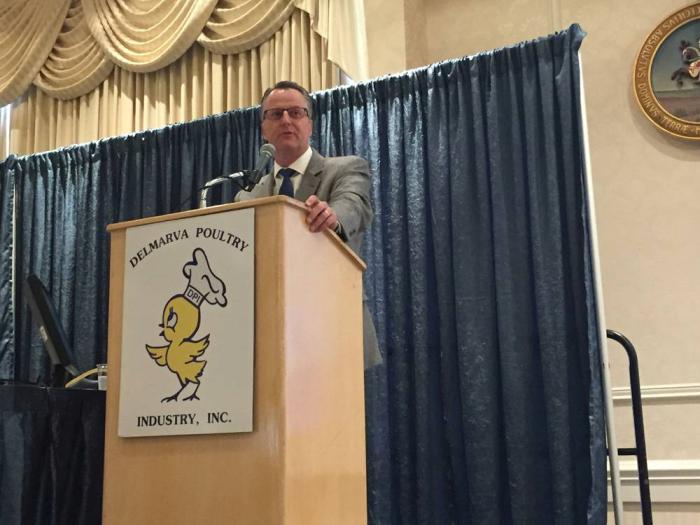
Today’s food system is safer, more available and more affordable than ever before, yet consumers have more questions than ever before because new communication technologies are taking away the industry’s ability to control messaging and tell its story. Instead of being defensive and providing scientific facts to “prove” something to consumers, poultry companies should use consumer skepticism as a reason to engage with consumers on a deeper level to tell their story, advised Charles Arnot, CEO of the Center for Food Integrity, speaking at the National Meeting on Poultry Health, Processing and Live Production on October 14.
The advent of digital and social media has consumer pressure and activism largely influencing views on animal agriculture as people crowdsource information from family, friends and other non-experts, making it critical for the poultry industry to identify the groups and people with whom they need to engage. Arnot suggested that female veterinarians, ideally also mothers, are the industry’s most effective channel for conveying its message.
But, facts are not what those consumers want in this messaging – they want to know that poultry companies share their values in seeking safe food for their families. In fact, according to Arnot, shared values are three to five times more important to building consumer trust than sharing facts. Consumers want to know poultry companies are ethically grounded, so companies must find more effective ways to demonstrate compassion, responsibility, fairness and truth.
“Our historical response has been science says we can, but society will tell us if we should,” Arnot said.
charlie-arnot-speaking
Charlie Arnot
Poultry companies have to understand that they must address this “should” question by engaging consumers. If not, efforts to educate the public will be unsuccessful.
“Consumers want information from academics, but they don’t want academic information,” he said.
 Instead of falling back on science, Arnot advised the poultry industry to shift its focus to asking how it can be a resource for consumers seeking safe, quality products. For example, the use of antibiotics in poultry production is seen by many consumers as contributing to resistance in humans; instead, companies need to engage with consumers in a way that communicates that antibiotics help to keep healthy food affordable for them, which is a top concern according to Arnot.
To increase transparency and gain consumer trust, Arnot offered three key takeaways:
1. Begin public engagement using shared values
2. Find ways to open the digital door to today’s poultry industry
3. Commit to engaging early, often and consistently
The Delmarva Poultry Industry 2015 National Meeting on Poultry Health, Processing and Live Production was held October 13-14 in Ocean City, Maryland.

Friday, October 16, 2015

VLP technology will help combat diseases threatening food-animal industry

LARAD, a startup using proprietary virus-like-particle (VLP) technology to develop vaccines and diagnostics for animal diseases, received a $470,000 Small Business Innovation Research grant to develop VLP vaccines for food-animal diseases. The two-year Phase II grant from the United States Department of Agriculture will allow LARAD to take the vaccine technology developed for infectious bursal disease with a Phase I grant and apply it to other food-animal diseases.
VLPs are similar to viruses and are recognized by the animal’s immune system, giving protection against the disease. But unlike conventional live virus vaccines, VLP vaccines do not contain any genetic material so they cannot cause disease. And while conventional vaccines become less effective as viruses mutate, LARAD can adapt its VLP vaccines to combat changing viruses.
“This customizability is a game-changing approach that hasn’t been possible in the animal vaccine industry until now,” said Dr. Daral Jackwood, LARAD founder and chief executive officer. “And its implications for the food industry are significant given the number of economically devastating animal diseases that are caused by viruses.”
LARAD will add at least two new vaccines to its arsenal with the Phase II funding. The company plans to develop a VLP vaccine against infectious pancreatic necrosis virus, which causes a disease in farm-raised salmonids, and avian reovirus, the cause of viral arthritis in poultry. Current vaccines for both diseases are only marginally effective due to changes that occur in the virus.
“Safe and affordable food is an important part of human health and wellness and diseases that affect food animals threaten the safety and quantity of this food source,” says Jackwood. “We are pleased that the USDA has chosen to support LARAD so we can develop adaptive vaccines that will help producers continue to provide a safe food supply.”

Monday, October 12, 2015

ConAgra Foods announces $300 million efficiency plan

ConAgra Foods, Inc., has announced restructuring plans to improve profitability, advance its growth agenda and unlock shareholder value. ConAgra Foods expects to realize at least $300 million of efficiency benefits within the next three years through a combination of reductions in SG&A and enhancements to trade spend processes and tools.
Cost savings of approximately $200 million are expected to be derived from a combination of lower headcount and non-headcount costs, which will be achieved by aggressively embracing zero-based budgeting, simplifying organizational structure by increasing spans of control and reducing layers, and outsourcing technology and back office functions to improve scalability. Additionally, the company expects to realize approximately $100 million of efficiency benefits from enhancements to trade spend processes and tools.
The company expects the plan to provide a modest benefit to fiscal year 2016 earnings. More than half the savings are anticipated to be realized by the end of fiscal year 2017 with the balance achieved in fiscal year 2018. These savings are in addition to the approximately $150 million in cost reductions achieved by the company over the past two years and are expected to enhance the company's cost-competitiveness, margins and agility, while also providing fuel for future brand-building and innovation initiatives.
The restructuring is expected to result in the elimination of approximately 1,500 positions or approximately 30% of the company’s global office-based workforce, and excludes any impact from the planned divestiture of the private label operations. Plant positions will not be eliminated in connection with this restructuring. ConAgra Foods estimates it will incur total non-recurring charges of approximately $345 million, substantially all of which are expected to be cash charges, over the next two to three years in connection with the restructuring.
The company also announced the relocation of its headquarters to Chicago, IL. Beginning in the summer of 2016, approximately 700 employees will be located in the new offices in the city’s Merchandise Mart, including the company’s senior leadership team and certain functions of the Consumer Foods business, which are currently located in Omaha, NE. and Naperville, IL. The company will continue to maintain a significant presence in Omaha, including approximately 1,200 employees within key administrative functions, as well as research & development and supply chain management.
“Today’s announcements are important milestones as we continue to execute against our strategic plan to build a focused, higher-margin, more contemporary and higher-performing company,” said Sean Connolly, president and chief executive officer, ConAgra Foods. “We are making difficult, but necessary, decisions to enhance productivity, drive standardization and enhance flexibility to deliver improved profitability. And through our organization redesign, we will better harness the power of our front line by deploying our talent against our largest opportunities for future growth and value creation.”
Connolly continued, “Locating our headquarters and our largest business segment in Chicago places us in the heart of one of the world’s business capitals and consumer packaged goods centers, enhancing our ability to attract and retain top talent with a focus on brand building and innovation.”
“Importantly, we will also retain a major presence in Omaha, where we have deep roots. Together with our new efficiency plan, we believe this geographic rebalancing will serve as a catalyst for improved organic and inorganic growth, and ultimately, stronger value creation for our shareholders.”
“We appreciate the strong support offered by both Mayor Rahm Emanuel and Governor Bruce Rauner during this process of evaluating a move to Chicago. Equally, we are grateful to Governor Pete Ricketts, Senator Heath Mello, Mayor Jean Stothert and Omaha Chamber President David Brown for the great support we have always received and continue to receive in Omaha. The decision to move headquarters was solely based on the strategic needs of our business and was not a city-vs-city exercise. We feel fortunate to have a meaningful relationship with two outstanding business centers,” concluded Connolly.
“I am thrilled to welcome ConAgra Foods' worldwide corporate headquarters to Illinois,” Governor Bruce Rauner said. “ConAgra has relied on the hardworking men and women of Illinois for almost 30 years, with over hundreds of employees calling our state their home. We look forward to the opportunities created by ConAgra's decision to invest in Illinois, and welcome them to their new home.”
“I am honored to welcome ConAgra Foods to the City of Chicago. By choosing Chicago as their new home, ConAgra Foods sees the same strengths that so many other companies see in relocating their headquarters here from our talent, to our transportation, to our quality of life,” said Mayor Rahm Emanuel. “This decision by ConAgra Foods further solidifies Chicago’s role as one of the world’s leading destinations for food processing companies. I look forward to watching them become part of Chicago’s future by creating even more jobs and opening up more opportunities for the residents of our city.”

Thursday, October 8, 2015

10 charged in China in connection to Husi Food scandal

Ten people who have been tied to a 2014 Chinese food safety scandal have been charged in court for their alleged involvement in the case.
According to an Industry Week report, the suspects have been charged by a Chinese court “on suspicions of producing, selling inferior products.”
The charges stem from an incident brought to light in July 2014, where employees of Husi Food Co., owned by the U.S.-based OSI Group, allegedly repackaged outdated chicken and beef, then allegedly sold the expired products with false labels to restaurant chains in China and Japan, including McDonald’s, KFC, Pizza Hut and Dico’s.
In a statement on its website, OSI Group said it would address the charges according to legal procedures, and “We have confidence in China’s legal system and believe that the judicial authority will come to a fair and reasonable judgment with full respect to the facts and laws.”
OSI Group has publicly apologized for the scandal. Sheldon Lavin, chairman, CEO and owner of OSI Group stated in 2014: “On behalf of Husi and OSI, I sincerely apologize to all of our customers in China. We will bear the responsibility of these missteps and will make sure that they never happen again. That is my personal commitment and that of our organization.”
Since the scandal took place, OSI Group made substantial changes to the organizational and management structures for its China operations. The company also closed the plant under investigation and removed Husi products from the marketplace.

Friday, October 2, 2015

Politics, public perception hurdles for global food supply

Geopolitical factors and public perception have a significant impact on the global food system, according to the panel discussion, “At the Intersection of Innovation, Regulation and Global Politics,” held during the Women in Agribusiness Summit in Minneapolis on September 30.
The panel, moderated by Jerry Steiner of AltaGrow Consulting LLC, featured Randy Giroux of Cargill, Bradley Shurdut of Dow AgriSciences, Marcella Szymanski from the U.S. Department of State, and Gloria Basse of Zoetis.
“As agriculture becomes much more global … it brings natural tensions that we need to work through,” Shurdut said.
The panelists discussed China and the regulatory and trade pressures the U.S. faces with the country.
“China is the largest agricultural customer in the world,” Giroux said. He added that China helps control grain prices in the U.S.
“China is a big dog because it drives the market,” Shurdut said.
Szymanski said the U.S. is sometimes treated differently than other grain exporters such as Brazil and Argentina because of the geopolitical nature of the U.S.-China relationship.
“There is more going on than just science-based approval,” she said. She also said China has transparency issues that go beyond agriculture.
Giroux said Chinese regulators are “in a bind” because they face a lot of pressure from consumers about what types of biotechnology to approve for importation.

Telling the ag message

The panel agreed that, in order for the agriculture industry to better get its message across to consumers, it must have a single message within the industry that is understood by the public.
Shurdut said farmers and growers have the most credibility in telling their own story.
“It’s an interesting time in the food industry,” Giroux said. He said that consumers now make the connection between the food they eat and their health.
“Biotech doesn’t equate with ‘clean label’ image,” he said. “There are a lot of compelling benefits to agriculture biotechnology, but the average consumer doesn’t understand them.”

Part of the conversation

When it comes to getting government regulators to understand technology used in agriculture, Shurdut said the agriculture community needs to engage in the discussion.
“Be part of the conversation,” he said, because many people in government who are regulating agriculture don’t have a background in the industry.
“As an industry, too often we have gotten caught behind,” Steiner said. “We need to be more anticipatory of issues and need to be better at getting ahead of them.”
Basse added: “We all want to preserve the health of our animals and ourselves and our families.” She said transparency on the part of farmers in important in building trust and spreading the message.

Thursday, September 24, 2015

Dr. George studies the science of 'yumminess'

Flamed-haired Dr. Georgina Crayford is a scientist by profession… but her passion is good food, and she’s just launched a Facebook page to share her obsession with other foodies.
In her professional life she studies international research papers, briefs politicians and civil servants, and helps farmers improve the health and welfare of Britain’s farm animals.
But away from the office she sheds her academic gravitas, lets down her hair, and immerses herself in an epicurean world where disciples of good taste debate the best ways to make crackling more crackly and artisan bacon more more-ish.
She’s grateful to her employers, the National Pig Association, for allowing her the freedom to pursue her hobby “even though it does sometime encroach on my working day”.
“George,” whose academic specialism is bioveterinary science and who is an expert in global surveillance of foodborne bacteria, hopes those who share her love for great food will contribute their most amazing pork recipes to her Great British Pork Facebook page at https://goo.gl/I0YtcG
“Lots of people have their own ideas about how to make the best bacon sandwich, the dreamiest pork curry and the quickest, easiest and tastiest ways of using pork mince, and I’d like to share them with everyone,” she said.
 “Despite what some of my colleagues may claim, it’s not about gluttony—although maybe that comes into it a bit….It’s about enjoying the pleasures of preparing and eating really good food that’s been cooked and presented imaginatively. And that’s something we all enjoy.”

Monday, June 15, 2015

Foster Farms antibiotic-free turkey coming soon

Thursday, May 28, 2015

Antibiotic-free broiler production is sustainable

Tuesday, May 26, 2015

Gift from The Nelson Foundation will support Food Science Lab Renovation at Iowa State University

Monday, May 25, 2015

4 perspectives on sustainable food production

Tuesday, May 12, 2015

4 types of antibiotics 2 Sisters doesn’t use in poultry

Monday, March 30, 2015

Israel researcher explores producing chicken meat in lab

  • Freeimages.com/
    Tel Aviv University's Amit Gefen has launched a project to study the possibility of producing chicken meat in a laboratory.
    From WATTAgNet:
    A Tel Aviv University professor has launched a research project studying the possibility of producing chicken meat in a laboratory. The study in Israel is being funded by the non-profit group Modern Agriculture Foundation (MAF), which advocates for laboratory-produced meat, also known as cultured meat.
    The study comes about two years after the creation of the first lab-grown hamburger at Maastricht University in the Netherlands.
    According to Amit Gefen, a Tel Aviv University bioengineer with an expertise in tissue engineering, and Shir Friedman, co-founder of MAF, producing lab-grown chicken meat is more difficult than beef. In the hamburger case, researchers accumulated small fibers of a cow’s muscle into a piece of meat. In the new project, Gefen says his plans are to use a single cell to generate a piece of chicken by allowing the cell to divide and multiply.
    Freidman says that the production of cultured meat and poultry could help meet the growing demand for food, specifically proteins. A Reuters report on the year-long feasibility research explains that producing cultured meat and poultry could be valuable because the global demand for poultry and other meat is expected to double by 2050.
    “In the not so distant future we will look back at how we used to raise cows and chickens and put so much effort into getting a small piece of meat,” Friedman said.

Friday, March 6, 2015

NAMI: More time needed to comment on dietary guidelines

Tuesday, March 3, 2015

Dietary guidelines: Eggs are fine, but limit meat consumption

  • Freeimages.com/alaev
    The 2015 Dietary Guidelines Advisory Committee has submitted its recommendations to the USDA and HHS secretaries.
    From WATTAgNet:
    The 2015 Dietary Guidelines Advisory Committee has submitted its recommendations to Health and Human Services Secretary Sylvia Burwell and Agriculture Secretary Tom Vilsack, in order to inform the 2015 edition of the Dietary Guidelines for Americans.
    The dietary guidelines back away from earlier guidelines that suggest avoiding foods high in cholesterol like eggs, while also recommending that Americans continue to limit the amount of meat consumed in meals.
    Committee says no need to avoid eggs
    The panel of nutrition and public health experts has recommended the withdrawal of a long-standing recommendation that Americans should avoid foods that are high in cholesterol -- advice that has put eggs off-limits for heart-healthy consumers for decades. The panel cited mounting research that consumption of cholesterol-rich foods, such as eggs, has little bearing on overall levels of cholesterol circulating in the bloodstream. Cholesterol from the diet represents only about 20 percent of the cholesterol circulating in the human bloodstream, and thus lowering cholesterol intake will affect blood cholesterol levels only marginally.
    Guidelines call for less meat in diet
    The committee also recommended that people continue a dietary shift from meat-heavy meals to more plant-based foods, defining a healthy diet as one that is “lower in red and processed meats; and low in sugar-sweetened foods and drinks and refined grains.”
    However, the report does not call for the end of meat in U.S. diets, adding, “that no food groups need to be eliminated completely to improve sustainability outcomes over the current status
    Public input on dietary guidelines sought
    Vilsack and Burwell have released the advisory committee's recommendations report online, making it available for public review and comment. The U.S. Departments of Health and Human Services (HHS) and Agriculture (USDA) will consider this report, along with input from other federal agencies and comments from the public as they develop the Dietary Guidelines for Americans, 2015, to be released later in 2015.
    "For decades, the Dietary Guidelines for Americans have been at the core of our efforts to promote the health and well-being of American families," said Secretaries Burwell and Vilsack in a joint statement. "Now that the advisory committee has completed its recommendations, HHS and USDA will review this advisory report, along with comments from the public-including other experts-and input from other federal agencies as we begin the process of updating the guidelines."
    The public is encouraged to view the independent advisory group's report and provide written comments at www.DietaryGuidelines.gov for a period of 45 days after publication in the Federal Register. The public will also have an opportunity to offer oral comments at a public meeting in Bethesda, Maryland, on March 24, 2015. Those interested in providing oral comments at the March 24, 2015, public meeting can register on the same website. Capacity is limited, so participants will be accepted on a first-come, first-served basis.
    About the dietary guidelines and advisory committee
    The 14 outside experts who made up the committee are nationally recognized in the fields of nutrition, medicine and public health. The committee held seven public meetings over the past two years. The recommendations of the 2015 Dietary Guidelines Advisory Committee are non-binding and advisory to HHS and USDA as they draft the Dietary Guidelines for Americans, 2015.
    The HHS Office of Disease Prevention and Health Promotion has the administrative lead for the Dietary Guidelines for Americans, 2015, which it carries out in close partnership with the USDA Center for Nutrition Policy and Promotion and with support from USDA's Agricultural Research Service.
    The Dietary Guidelines for Americans was first published in 1980. Beginning in 1990, Congress mandated that HHS and USDA release a new edition at least every five years. The Dietary Guidelines contain the latest, science-based nutrition recommendations for the general public with the goal of preventing disease and promoting healthy, active lifestyles. It is written for and used primarily by nutrition and health professionals, policy makers and educators, and is the foundation for federal nutrition efforts, including education initiatives and food assistance programs.