Showing posts with label US egg production. Show all posts

Friday, October 16, 2015

Year-ending US egg prices may return to normal levels

The number of table egg-laying hens in the U.S. might not fully recover from the losses stemming from the highly pathogenic avian influenza outbreak in the Upper Midwest this spring until 2017, but don’t expect the current run of high wholesale egg prices to last that long.
Brian Moscogiuri, market reporter, U.S. and European egg markets, Urner Barry, said that the run-up of U.S. egg prices to record high levels that resulted from the loss of more than 40 million layers and pullets in the U.S. may be over by the end of 2015. He told the audience at the United Egg Producers annual convention in New Orleans that the reason egg prices may return to more normal levels is because of some recovery of layer numbers and lost exports.
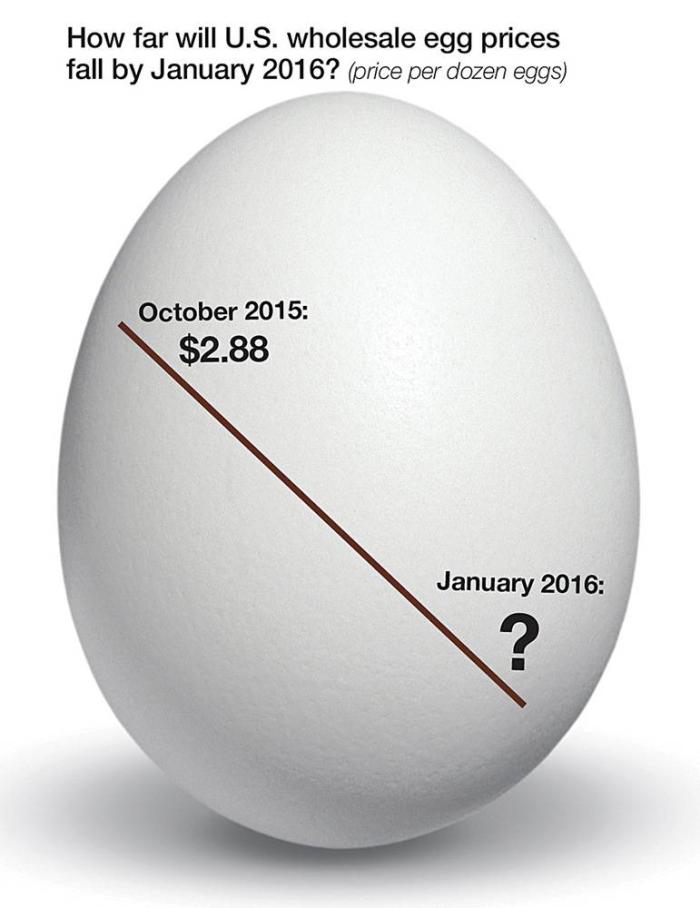
egg-price-chart
The current high wholesale prices for eggs should not last long, but where they will end up toward the end of 2015 remains to be seen.
The U.S. exported around 5 percent of its total egg production in 2014. Because of export bans and high prices, the eggs and egg products that would have been exported in a normal year aren’t being exported, and this represents about 15 million hens worth of production.
Monthly U.S. layer numbers were running around 270 million head, 35 million head below last year’s levels, throughout the summer of 2015. The Egg Industry Center’s U.S. Flock Trends and Projections Report released on October 8, 2015, predicts that the U.S. layer flock will recover to 288.5 million head by the end of 2015.
Essentially, Moscogiuri said that if the U.S. layer flock gets to 290 million by year’s end, U.S. egg prices should come back to more normal levels, because the roughly 20-million-bird increase from the summer flock numbers and the lost exports of 15 million birds worth of production will bring the available domestic supply back to 2014 levels.
He pointed out that there has been substitution for eggs and egg products going on in the market because of high prices. It is not known how much substitution will continue after prices for eggs and egg products return to more normal levels. Another complicating factor in any price prediction is the fact that, in spite of relatively high egg prices prior to the avian influenza outbreak, U.S. per capita egg consumption had increased to its highest level in 30 years.
It is possible that McDonald’s U.S. all-day breakfast roll out October 6, 2015, will give demand for eggs another boost and help to maintain high egg prices, at least for a little while longer. Current U.S. imports of eggs are helping to mitigate U.S. production losses caused by avian influenza, but these imports have only replaced about one-fifth of the lost production. Look for the overseas imports of eggs into the U.S. to end when the spread between U.S. and EU prices falls to close to $0.50 per dozen. The spread reached as high as $1.50 per dozen this summer, Moscogiuri reported.

Wednesday, September 2, 2015

Infographic: US egg farms recovering after avian flu

United Egg Producers | U.S. egg farms are repopulating, but it could take a year before the U.S. egg industry reaches the production levels it attained before the 2015 avian influenza outbreak.
Recovery is underway for the U.S. egg industry after the devastating outbreak of avian influenza (AI) during the spring of 2015. While repopulation of flocks on affected Midwestern egg farms continues, egg farmers across the nation are also increasing biosecurity measures and preparing for the possible return of the virus during the fall migratory season.
“Egg farmers affected by AI this spring have been working diligently and are making good strides toward resuming egg production,” said Chad Gregory, president and CEO of United Egg Producers (UEP). While some of the farms affected earliest in the outbreak time period are beginning to bring young hens back into their barns, Gregory said it will be at least 12 to 18 months before egg production returns to full, pre-avian influenza levels. In addition, farms repopulating must meet stringent cleaning and disinfection regulations defined by USDA-APHIS, before they can repopulate.
It may take up to 80 weeks to fully repopulate some farms because the age of hens is deliberately staggered to collectively produce the right amount of eggs to meet customer needs on a consistent, ongoing basis.
Adding to the challenge is a short supply of pullets. This short supply has been created by the overwhelming need for more pullets at one time as egg farmers start to fill layer barns. Additionally, avian influenza was detected on some breeder and pullet farms, which reduced the number of birds available at early stages of the repopulation process. One breeder hen provides the equivalent of 120 chicks, which makes the loss of breeder flocks even more impactful on the egg supply.

Biosecurity taken to new levels

Although biosecurity and disease prevention have been a priority on egg farms for decades, the uncontrollable and rapid spread of avian influenza this spring stymied even the best efforts of farmers and animal health experts. In response, U.S. egg farms have enhanced biosecurity measures intended to further protect their flocks, with a focus on these key areas:
  • Increasing protocols for controlled movement of workers, birds, vehicles and equipment,
  • Ensuring feed and water are not at risk of virus contamination and
  • Limiting contact with domesticated and wild birds.
Egg farms are tightening vehicle restrictions, increasing disinfection procedures and expanding worker training. UEP has reviewed and summarized chapters of biosecurity recommendations from USDA-APHIS for its members, and the American Egg Board distributed biosecurity enhancement recommendations to all commercial egg farmers.
Methods proposed to increase biosecurity range from minor procedural shifts to large investments in equipment and facilities. All egg farmers have been encouraged to work with veterinarians and animal health experts to evaluate current biosecurity programs, consider new recommendations from industry experts, and adjust based on new learnings from AI.
“We pledge our best efforts to overcome this setback and re-build a healthy and viable egg industry,” Gregory said. “It is vital that we continue to work diligently and collaboratively to protect the health and well-being of our flocks, egg farms and rural communities.” 

Monday, November 3, 2014

Rose Acre Farms to expand egg operations into Arizona

Thursday, July 31, 2014

Cal-Maine, Hickman’s Egg Ranch enter joint venture

Friday, July 26, 2013

Cal-Maine settles egg antitrust class action claims

    Cal-Maine Foods Inc. announced that it has reached an agreement in principle to settle all direct purchaser class claims against the company. Pursuant to the agreement, reached in the In re Processed Egg Products Antitrust Litigation matter pending in Pennsylvania federal court, Cal-Maine will settle all direct purchaser class claims with a single $28 million payment.
    “We remain confident that our conduct has at all times been lawful, appropriate and fair to our customers. The largest retailers and egg buyers in the country, including many of our customers, in fact, were fully aware of, and explicitly supported, the industry-wide animal welfare guidelines challenged in this litigation. And, the USDA was fully aware of, and explicitly supported, these animal welfare guidelines as well as all the other conduct the plaintiffs challenged,” said Dolph Baker, chairman, president and CEO of Cal-Maine Foods Inc. “We were able to negotiate a settlement, which would eliminate most of our exposure in the antitrust litigation against the company for an amount that we believe is in the best interest of the shareholders, employees, customers and consumers. It significantly reduces the distraction, expense, exposure and inconvenience of protracted litigation and potentially multiple appeals, and allows us to focus on executing the long-term strategy of our business.”
    The terms of the settlement must be formally documented and are subject to approval by the court following notice to all class members. Cal-Maine will record a pre-tax charge in the fourth quarter of fiscal 2013 of approximately $28 million with respect to the settlement, which amounts to $17 million, $0.71 per basic share, after tax. Cal-Maine does not expect other provisions associated with the settlement to have a material impact on its results of operations. While the company expects the settlement will receive the needed approval, there can be no assurance that the court will approve the agreement as proposed by the parties.
    The plaintiffs in the non-class cases that direct purchasers have filed against the company may elect to participate in the settlement or to opt out and pursue their individual claims. The settlement does not affect the class actions filed on behalf of indirect purchasers. These non-class cases and the indirect purchaser class actions also allege that the company and certain other large domestic egg producers conspired to reduce the domestic supply of eggs in an effort to raise egg prices. Cal-Maine announced that it intends to continue to vigorously defend the remaining cases and believes it has strong defenses.

Thursday, June 27, 2013

US egg production up 3 percent in May, latest USDA report shows

    Egg production in the United States totaled 8.02 billion during May, up 3 percent from May 2012, according to the US Department of Agriculture's latest Chickens and Eggs report, released June 21. Production included 6.92 billion table eggs and 1.10 billion hatching eggs, of which 1.02 billion were broiler-type and 79 million were egg-type.
    Layers
    The total number of layers during May averaged 345 million, up 1 percent from May 2012. May egg production per 100 layers was 2,327 eggs, up 1 percent from May 2012.
    All layers in the U.S. on June 1 totaled 346 million, up 2 percent from June 2012. The 346 million layers consisted of 289 million layers producing table or market-type eggs, 53.5 million layers producing broiler-type hatching eggs and 3.15 million layers producing egg-type hatching eggs. Rate of lay per day on June 1 averaged 75.2 eggs per 100 layers, up 1 percent from June 1, 2012.
    Egg-type chicks hatched
    Egg-type chicks hatched during May totaled 48.3 million, up 8 percent from May 2012. Eggs in incubators totaled 42.4 million on June 1, up 10 percent from June 1, 2012.
    Domestic placements of egg-type pullet chicks for future hatchery-supply flocks by leading breeders totaled 215,000 during May, down 29 percent from May 2012.
    Broiler-type chicks hatched
    Broiler-type chicks hatched during May totaled 775 million, down slightly from May 2012. Eggs in incubators totaled 634 million on June 1, up 1 percent from June 1, 2012.
    Leading breeders placed 7.49 million broiler-type pullet chicks for future domestic hatchery supply flocks during May, up slightly from May 2012.

Tuesday, June 18, 2013

USDA raises broiler, egg production forecasts

    The forecasts for broiler and egg production in the United States have been raised in June, according to the United States Department of Agriculture's World Agricultural Supply and Demand Estimates report, released on June 12.
    Broiler forecast
    The USDA forecast for broiler production in 2013 was raised from the 37.34 billion pounds projected in May to a 37.36 billion pound estimate in June. A slight increase in slaughter is expected, based off of hatchery data. The agency's projections for 2014 production remained steady at 38.4 billion pounds.
    The USDA's projection for 2013 broiler exports increased from the 7.26 billion pounds projected in May to a 7.36 billion pound estimate in June.
    Egg forecast
    The forecast for egg production was raised from the May estimates, reflecting slightly higher table egg production in the third quarter. U.S. egg production for 2013 was estimated at 7,879 million dozen in the June report, compared to the 7,864 million forecast in May. The projections for 2014 production were unchanged at 8,051 million dozen.
    The agency also raised its forecast for egg exports, projecting 2013 exports at 287.2 million dozen, compared to its May estimate of 273.2 million dozen. The export forecast for 2014 did not change in June, with the estimate at 287 million dozen.
    Turkey forecast
    The USDA's 2013 turkey production forecast saw no change in June, with an estimate of 5.88 billion pounds. The 2014 production forecast also stayed steady at 6.2 billion pounds.
    The U.S. turkey export forecast for 2013 was raised in June to 783 million pounds from the 713 million pounds forecast in May.

Friday, May 24, 2013

Reconciliation process will be the key to hopes of Egg Bill passage


    Proponents of the Egg Bill (H.R. 1731 and S. 820) were unable to get this legislation added as an amendment to the Farm Bill in either the Senate or House Agriculture Committees. Agriculture groups who oppose the Egg Bill had too much influence on these committees and were able to block the legislation. But, Mike McLeod of McLeod, Watkinson & Miller, a law firm representing the United Egg Producers, said that the struggle to secure passage of the Egg Bill is far from over.
    Speaking at the United Egg Producers' Legislative Board and Committee Meetings, McLeod said that the real battleground for the Egg Bill will be on the floor of the House of Representatives; because it is there that the influence of the Humane Society of the United States will be felt the most. Proponents of the Egg Bill will need to get two things accomplished on the House floor, according to McLeod. The so-called King amendment will need to be removed from the Farm Bill and the Egg Bill amendment will need to be added.
    The King amendment, which would not allow a state to restrict movement of agricultural products into the state from other states, was added to the Farm Bill as an amendment by the House Agriculture Committee. McLeod called the King amendment the "anti-Egg Bill," but he said that some lawyers have espoused the position that the King amendment would be found to be unconstitutional if enacted and challenged in court.
    If the King amendment is removed from the Farm Bill on the floor of the House and the Egg Bill amendment is added, then the reconciliation process can result in the Egg Bill being part of the final Farm Bill legislation. McLeod said that action on the Farm Bill on the House floor should begin around June 16. 

Wednesday, March 27, 2013

February egg production down 1 percent from 2012


    February egg production in the United States dropped by one percent from the same month a year ago, with broiler-type chicks hatched down two percent, but egg-type chicks hatched up by four percent.
    According to the most recent USDA Chickens and Eggs report, total egg production amounted to 7.19 billion for the month, which included 6.23 billion table eggs and 962 million hatching eggs. Of the hatching eggs, 893 million were broiler-type, and 69 million were egg-type.
    Egg-type chicks hatched in February amounted to 40.8 million, up four percent from February, 2012, while eggs in incubators totaled 41.8 million on March 1, up six percent from a year ago.
    Broiler-type chicks hatched during February totaled 690 million, down two percent from February 2012. Eggs in incubators totaled 622 million on March 1, up 2 percent from a year earlier.

    Layer supply, rate of lay both increase
    All layer hens in the U.S. on March 1 totaled 345 million, up 2 percent from last year. Of those, 291 million were producing table or market-type eggs, 51.7 million produced broiler-type eggs and 2.98 million layers were producing egg-type hatching eggs.
    The rate of lay per day on March 1 averaged 74.3 eggs per 100 layers, which is up slightly from the same day a year ago.

Thursday, November 29, 2012

US October egg production up 2 percent


    U.S. egg production totaled 7.9 billion during October, up 2 percent from 2011 numbers, according to the U.S. Department of Agriculture's latest report.
    Production included 6.88 billion table eggs, and 1.02 billion hatching eggs, of which 952 million were broiler-type and 69 million were egg-type. The total number of layers during October averaged 340 million, up 1 percent from 2011. October egg production per 100 layers was 2,321 eggs, up slightly from October 2011.
    All layers in the U.S. on November 1 totaled 342 million, up 2 percent from 2011 numbers. The 342 million layers consisted of 291 million layers producing table- or market-type eggs, 49.1 million layers producing broiler-type hatching eggs and 2.82 million layers producing egg-type hatching eggs. Rate of lay per day on November 1, averaged 75.4 eggs per 100 layers, up 1 percent from November 1, 2011, according to the USDA report.
    Egg-type chicks hatched during October totaled 39.1 million, up 4 percent from October 2011. Eggs in incubators totaled 35 million on November 1, down 7 percent from 2011 numbers. Domestic placements of egg-type pullet chicks for future hatchery supply flocks by leading breeders totaled 196,000 during October, down 26 percent from October 2011.
    Broiler-type chicks hatched during October totaled 727 million, up 2 percent from October 2011. Eggs in incubators totaled 569 million on November 1, down 1 percent from 2011, according to the USDA. Leading breeders placed 6.22 million broiler-type pullet chicks for future domestic hatchery supply flocks during October, down 1 percent from October 2011.
    For more information and statistics on U.S. egg production, see www.wattagnet.com/marketdata.html.

Tuesday, October 30, 2012

US egg production up slightly in September


    U.S. egg production totaled 7.55 billion during September, up 1 percent from 2011 numbers, according to the U.S. Department of Agriculture's latest report.
    Production included 6.57 billion table eggs, and 987 million hatching eggs, of which 919 million were broiler-type and 68 million were egg-type. The total number of layers during September averaged 337 million, up 1 percent from 2011. September egg production per 100 layers was 2,241 eggs, up slightly from September 2011, according to the USDA.
    All layers in the U.S. on October 1 totaled 338 million, up 1 percent from 2011 numbers. The 338 million layers consisted of 285 million layers producing table- or market-type eggs, 49.3 million layers producing broiler-type hatching eggs, and 2.96 million layers producing egg-type hatching eggs. Rate of lay per day on October 1 averaged 74.3 eggs per 100 layers, down 1 percent from October 1, 2011.
    Egg-type chicks hatched during September totaled 37.5 million, down 6 percent from September 2011. Eggs in incubators totaled 37.2 million on October 1, up 1 percent from 2011 numbers, according to the USDA report. Domestic placements of egg-type pullet chicks for future hatchery supply flocks by leading breeders totaled 206,000 during September, down 18 percent from September 2011.
    Broiler-type chicks hatched totaled 718 million, down slightly from September 2011. Eggs in incubators totaled 581 million on October 1, up 2 percent from 2011 numbers. Leading breeders placed 6.68 million broiler-type pullet chicks for future domestic hatchery supply flocks during September 2012, up slightly from September 2011.
    For more egg and poultry information and statistics, see www.wattagnet.com/marketdata.html

Wednesday, September 26, 2012

US egg production up slightly in August


    U.S. egg production totaled 7.8 billion during August, up 1 percent from 2011 numbers, according to the U.S. Department of Agriculture's latest report.
    Production included 6.76 billion table eggs, and 1.04 billion hatching eggs, of which 971 million were broiler-type and 69 million were egg-type. The total number of layers during August averaged 335 million, up slightly from 2011. August egg production per 100 layers was 2,324 eggs, up 1 percent from August 2011. All layers in the U.S. on September 1 totaled 336 million, up slightly from 2011, according to the USDA. The 336 million layers consisted of 284 million layers producing table or market type eggs, 49.8 million layers producing broiler-type hatching eggs and 2.84 million layers producing egg-type hatching eggs.
    Egg-type chicks hatched during August totaled 41.4 million, down slightly from August 2011. Eggs in incubators totaled 36.8 million on September 1, down 6 percent from 2011 numbers. Domestic placements of egg-type pullet chicks for future hatchery supply flocks by leading breeders totaled 234,000, down 26 percent from August 2011.
    Broiler-type chicks hatched in August totaled 758 million, also down slightly from August 2011. Eggs in incubators totaled 596 million on September 1, down 1 percent from 2011 numbers, according to the USDA. Leading breeders placed 7.05 million broiler-type pullet chicks for future domestic hatchery supply flocks during August 2012, down 3 percent from August 2011.

Monday, September 24, 2012

US table egg flock up in July


    In July, the number of birds in the U.S. table egg flock was 281.1 million, up just under 1 percent from 2011 numbers, according to the latest U.S. Department of Agriculture report.
    The table egg flock has been larger year-over-year throughout 2012. With the increase in the table egg flock, table egg production has increased. Over the first seven months of 2012, table egg production has totaled 3.9 billion dozen, 1.1 percent higher than in 2011. Table egg production is expected to continue to be higher in the third quarter of 2012 but to fall in the fourth quarter, and production is also expected to be lower in 2013. The decrease, like that for broilers and turkeys, is expected to stem from a contraction in production arising from higher feed costs.
    The hatching flock for meat-type birds (broiler-breeder flock) was reported at 51.1 million in July, down 6 percent from 2011, according to the USDA. The number of meat-type hens in the broiler-hatchery flock has been significantly lower on a year-over-year basis since mid-2011. The lower number of hens reflects the decreases in broiler chick demand as broiler integrators cut back expansion plans due to high grain prices and relatively weak domestic demand.
    In July and August 2012, the weekly wholesale price for eggs in the New York market had a short-lived but sharp spike in prices. Prices at the beginning of July averaged around $1.05 per dozen and then rose to almost $1.60 per dozen, before falling back to around $1.16 per dozen by the beginning of September. Since the beginning of September, prices have begun to recover, said the USDA.
    With this run-up in egg prices, the third-quarter 2012 average for New York egg prices is now expected to be $1.26–$1.29 per dozen, up almost $0.12 from the third quarter of 2011. Prices in the fourth quarter of 2012 are forecast at $1.32–$1.38 per dozen. This strengthening in prices in the fourth quarter is expected to come from a slow growth in production in the face of the normal increase in seasonal demand.
    For more information and statistics on U.S. poultry and eggs, see www.wattagnet.com/marketdata.html

Monday, August 27, 2012

US egg production reduced for 2013


    The forecast for U.S. total domestic egg production in 2013 has been lowered by 100 million dozen to 7.5 billion dozen, down 2 percent from the 2012 forecast, according to the U.S. Department of Agriculture's latest report. The lower production, brought on by higher feed costs, is expected to result in higher domestic prices and lower exports in 2013.
    In the first half of 2012, table egg production was 3.3 billion dozen, up 1.1 percent from the first half of 2011. However, production of hatching eggs fell by 3.7 percent compared with 2011 numbers. The decrease in hatching egg production was chiefly the result of the decline in broiler chicks needed for growout, according to the USDA. Hatching egg production in the first half of 2012 was 520 million dozen. Production of table eggs is expected to be down slightly in the second half of 2012 and through 2013. Production of hatching eggs, especially those from meat-type birds, is expected to be below 2011 levels in the second half of 2012 as broiler chick production declines.
    Wholesale prices in the New York market for a dozen grade A large eggs in the second quarter averaged $0.98 per dozen, at the end of July. However, moving into August, prices have spiked to over $1.50 per dozen. Even with table egg production expected to be slightly higher in the second half of 2012, prices are expected to be stronger than in 2011 through the end of 2012. Wholesale prices in the New York market for a dozen Grade A large eggs are forecast to average $1.28–$1.32 for the third quarter of 2012 and average $1.31–$1.39 in the fourth quarter, according to the USDA's report.
    For more information and statistics on U.S. eggs, see www.wattagnet.com/marketdata.html.  

Tuesday, July 31, 2012

US Senate discusses egg-laying hen welfare


    On July 27 a U.S. Senate committee discussed legislation to set national standards for the treatment of egg-laying hens, debating particularly how much space each hen should have in their coops, according to reports.
    The proposed legislation, promoted by Senator Dianne Feinstein, would increase the size of henhouses and require egg labeling so consumers know how hens were raised. "This is a practical, fair-minded deal that solves a real problem for the egg industry," said Feinstein. Her effort to create national standards is partly the result of an initiative passed by Californians in 2008 that require that hens be able to stretch their wings and turn around in their housing. At least five other states have enacted similar rules. The legislation also takes into account a compromise reached in 2011 between the Humane Society of the United States and United Egg Producers.
    The bill gives farmers 18 years to increase the size of hen cages. The measure would also outlaw the practice of depriving hens of food and water to increase egg production, set minimum air quality standards for henhouses and require that egg cartons stipulate whether eggs come from hens that are caged, cage-free, free-range or housed in enriched cages. Currently, the majority of caged hens are provided with 67 square inches of space. If the legislation passes, the hens would be given 124 to 144 square inches of space.
    Groups representing beef and pork industries have come out against Feinstein's bill, and a companion bill in the House sponsored by Representative Kurt Schrader, saying that they might be the next target of federal legislation. An industry group called Egg Farmers of America is also opposed to the legislation, saying that it could drive small farmers out of business, increase consumer prices, affect other industries and lacks scientific justification.

Friday, July 27, 2012

US egg production down slightly in June


    U.S. egg production totaled 7.5 billion during June, down slightly from 2011, according to the latest U.S. Department of Agriculture report.
    Production included 6.47 billion table eggs, and 1.03 billion hatching eggs, of which 965 million were broiler-type and 68 million were egg-type. The total number of layers during June averaged 337 million, up slightly from 2011. June egg production per 100 layers was 2,227 eggs, down slightly from June 2011, according to the USDA. All layers in the U.S. on July 1 totaled 335 million, down slightly from 2011 totals. The 335 million layers consisted of 281 million layers producing table- or market-type eggs, 51.6 million layers producing broiler-type hatching eggs and 2.81 million layers producing egg-type hatching eggs. Rate of lay per day on July 1 averaged 73.9 eggs per 100 layers, down 1 percent from July 1, 2011.
    Egg-type chicks hatched during June totaled 39.4 million, up 1 percent from June 2011. Eggs in incubators totaled 34.2 million on July 1, down 1 percent from 2011 numbers. Domestic placements of egg-type pullet chicks for future hatchery supply flocks by leading breeders totaled 119,000 during June, down 61 percent from June 2011.
    Broiler-type chicks hatched during June totaled 756 million, down 1 percent from June 2011. Eggs in incubators totaled 612 million on July 1, down 1 percent from 2011, according to the USDA. Leading breeders placed 6.8 million broiler-type pullet chicks for future domestic hatchery supply flocks during June, down 6 percent from June 2011.
    For more egg and poultry information and statistics, see www.wattagnet.com/marketdata.html

Thursday, June 28, 2012

US egg production down slightly in May


    U.S. egg production totaled 7.77 billion during May, down slightly from 2011 numbers, according to the U.S. Department of Agriculture's latest report. Production included 6.69 billion table eggs, and 1.08 billion hatching eggs, of which 1.01 billion were broiler-type and 73 million were egg-type.
    The total number of layers during May averaged 338 million, up slightly from the same time in 2011. May egg production per 100 layers was 2,296 eggs, down slightly from May 2011.
    All layers in the U.S. on June 1 totaled 338 million, up slightly from 2011 numbers. The 338 million layers consisted of 282 million layers producing table- or market-type eggs, 52.9 million layers producing broiler-type hatching eggs and 2.96 million layers producing egg-type hatching eggs. Rate of lay per day on June 1 averaged 74.4 eggs per 100 layers, up slightly from June 1, 2011.
    Egg-type chicks hatched during May totaled 43.3 million, up 1 percent from May 2011. Eggs in incubators totaled 40.3 million on June 1, up 8 percent from the same time in 2011. Domestic placements of egg-type pullet chicks for future hatchery supply flocks by leading breeders totaled 302,000 during May, up 54 percent from May 2011.
    Broiler-type chicks hatched during May totaled 778 million, down 3 percent from May 2011 numbers. Eggs in incubators totaled 626 million on June 1, down 2 percent from the same time in 2011. Leading breeders placed 7.48 million broiler-type pullet chicks for future domestic hatchery supply flocks during May, down 3 percent from May 2011.
    For more egg and poultry information and statistics, see www.wattagnet.com/marketdata.html.  

Monday, June 25, 2012

Moark to add 1 million chickens to Missouri business


    Moark has plans to expand its Missouri business with 12 new layer and pullet houses for up to 1 million birds, according to reports.
    Area residents, who unsuccessfully protested the last expansion, said they will not fight these latest plans. They previously cited a history of pollution by the company and pointed to concerns about odors and water quality, which they said would affect their ability to use their homes and would undermine their property values.
    Moark contacted all residents who live within 4,500 feet (nearly nine-tenths of a mile) of the chicken houses and waste sites it plans to build. All waste generated by the birds will be collected and transported to a manure holding and composting building, where it will be kept dry and outside air will be blown over it to further dry it. The dry manure will be moved to a nearby composting operation or can be hauled off and applied to farm fields, where it is supposed to be spread according to state regulations.

Wednesday, May 30, 2012

US egg production, chicks hatched down in April


    U.S. egg production totaled 7.58 billion during April, down 1 percent from 2011 numbers, according to the U.S. Department of Agriculture's latest report, including 6.54 billion table eggs, and 1.04 billion hatching eggs, of which 964 million were broiler-type and 73 million were egg-type.
    The total number of layers during April averaged 339 million, down slightly from 2011. April egg production per 100 layers was 2,233 eggs, down slightly from April 2011. All layers in the U.S. on May 1 totaled 338 million, down slightly from the same time in 2011. The 338 million layers consisted of 283 million layers producing table or market type eggs, 52.8 million layers producing broiler-type hatching eggs and 2.98 million layers producing egg-type hatching eggs. Rate of lay per day on May 1 averaged 73.6 eggs per 100 layers, down 1 percent from May 1, 2011.
    Egg-type chicks hatched during April totaled 39.7 million, down 8 percent from April 2011, according to the USDA. Eggs in incubators totaled 42 million on May 1, up 4 percent from 2011 numbers. Domestic placements of egg-type pullet chicks for future hatchery supply flocks by leading breeders totaled 172,000 during April, down 40 percent from April 2011.
    Broiler-type chicks hatched during April totaled 748 million, down 4 percent from April 2011. Eggs in incubators totaled 619 million on May 1, down 4 percent from 2011 numbers. Leading breeders placed 6.52 million broiler-type pullet chicks for future domestic hatchery supply flocks during April, down 7 percent from April 2011.
    For more egg and poultry information and statistics, see www.wattagnet.com/marketdata.html.  

Friday, May 18, 2012

US turkey eggs, poults up over 2011 numbers


    U.S. turkey eggs in incubators on May 1 totaled 30 million, up 8 percent from 2011 numbers, according to the U.S. Department of Agriculture's latest report. Eggs in incubators were up 6 percent from the April 1 total of 28.2 million eggs.
    Turkey poults hatched during April totaled 24.2 million, up 2 percent from April 2011 numbers. Poults hatched were down 4 percent from the March total of 25.2 million poults. The 23.8 million net poults placed during April were up 2 percent from the number placed during the same month in 2011, according to the report. Net placements were down 5 percent from the March total of 25.1 million.
    For more poultry information and statistics, see www.wattagnet.com/marketdata.html.